Every compression sock is defined by a number written as a range, like 15-20 or 20-30, and measured in millimeters of mercury, the same mmHg unit used for blood pressure. That number is the single most important spec on the sock, and it is also the one most often chosen by guesswork. For a buyer speccing custom or branded compression socks, understanding the ladder of compression levels, how the American and European standards differ, and where the line sits between a wellness product and a medical one is what keeps an order both effective and legally clean. This is a standards explainer, not medical advice, and where an individual’s health is involved a clinician should have the final word.
The mmHg ladder, from mild to medical
Compression is graduated, meaning the pressure is highest at the ankle and eases as it moves up the leg, and the number on the box is the pressure at that tightest point. The commonly sold levels form a ladder. 8-15 mmHg is mild, the everyday, energizing level for tired and achy legs. 15-20 mmHg is moderate and the most popular wellness and athletic range, used for mild swelling, long flights, pregnancy comfort, and general leg fatigue. 20-30 mmHg is firm and the point where the product becomes genuinely medical, used for varicose veins, edema, and post-procedure recovery. 30-40 mmHg is extra firm, for moderate-to-severe swelling and venous conditions, and 40-50 mmHg is reserved for serious chronic venous disease. The chart below lays out the full ladder.
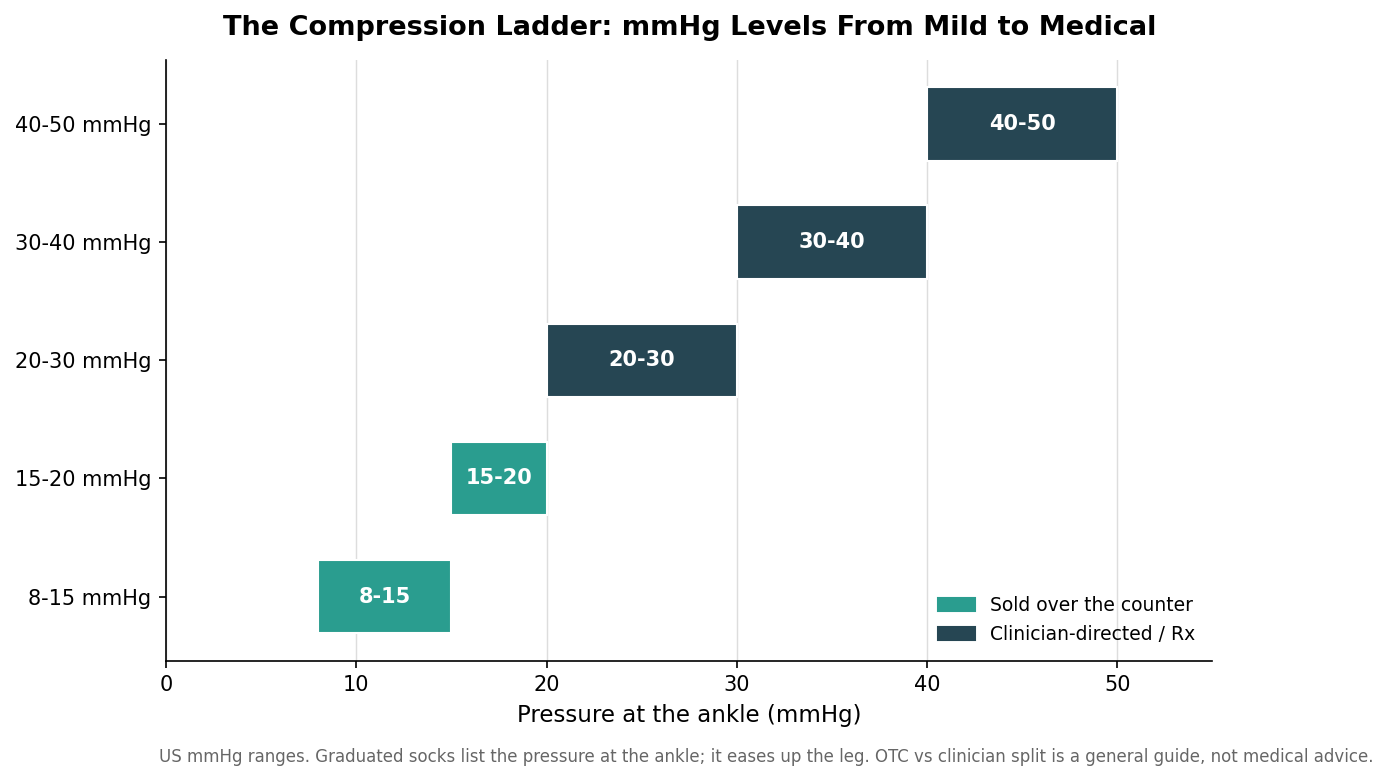
The practical takeaway from the ladder is that the jump from 15-20 to 20-30 is not just one notch tighter; it is the boundary between a comfort product anyone can buy and a therapeutic one that should involve a clinician.
Two standards that do not line up
Here is where buyers get tripped up. The United States market describes compression in those mmHg ranges, while Europe uses the RAL compression classes, and the two systems do not map cleanly onto each other. Under the German RAL-GZ 387 standard, Class 1 is 18 to 21 mmHg, Class 2 is 23 to 32, Class 3 is 34 to 46, and Class 4 is 49 mmHg and above. Notice that a US 20-30 sock straddles the boundary between RAL Class 1 and Class 2, so a product labeled “Class 2” in Europe is not identical to any single US range.
If your socks are being knit overseas, this matters. A factory quoting compression in RAL classes is not speaking the same language as a US spec sheet listing 15-20 mmHg, and “close enough” can put the finished sock a full level off what you intended. Always pin the spec to an explicit mmHg range at the ankle and confirm which testing standard the manufacturer certifies to, rather than trusting a class label to translate.
Over-the-counter versus clinician territory
The regulatory reality follows the ladder closely. In the US, compression up to roughly 15-20 mmHg is broadly sold over the counter as a wellness and comfort product, no prescription and no gatekeeping. At 20-30 mmHg the products are frequently recommended or fitted through a clinician, and by 30-40 and 40-50 mmHg they are genuinely therapeutic and should be worn under medical supervision, because the wrong high-compression garment on the wrong leg, for someone with arterial disease or certain other conditions, can do harm rather than good.
For a custom program, this draws a clean line. If you want socks anyone on a team, in an office, or at an event can put on without a fitting or a warning, you want to stay at or below 15-20 mmHg. The moment you climb into 20-30 and above, you are selling something that behaves like a medical device, with the fitting, sizing precision, and caution that implies.
Where custom and branded programs actually sit
In practice, the overwhelming majority of custom, branded, and team compression socks live in the 15-20 mmHg band, with some athletic recovery and all-day-standing programs reaching into 20-30. That is not a limitation; it is the right place for a product meant to be comfortable, broadly wearable, and marketed on recovery and freshness rather than treatment. The chart below shows where common uses typically land.
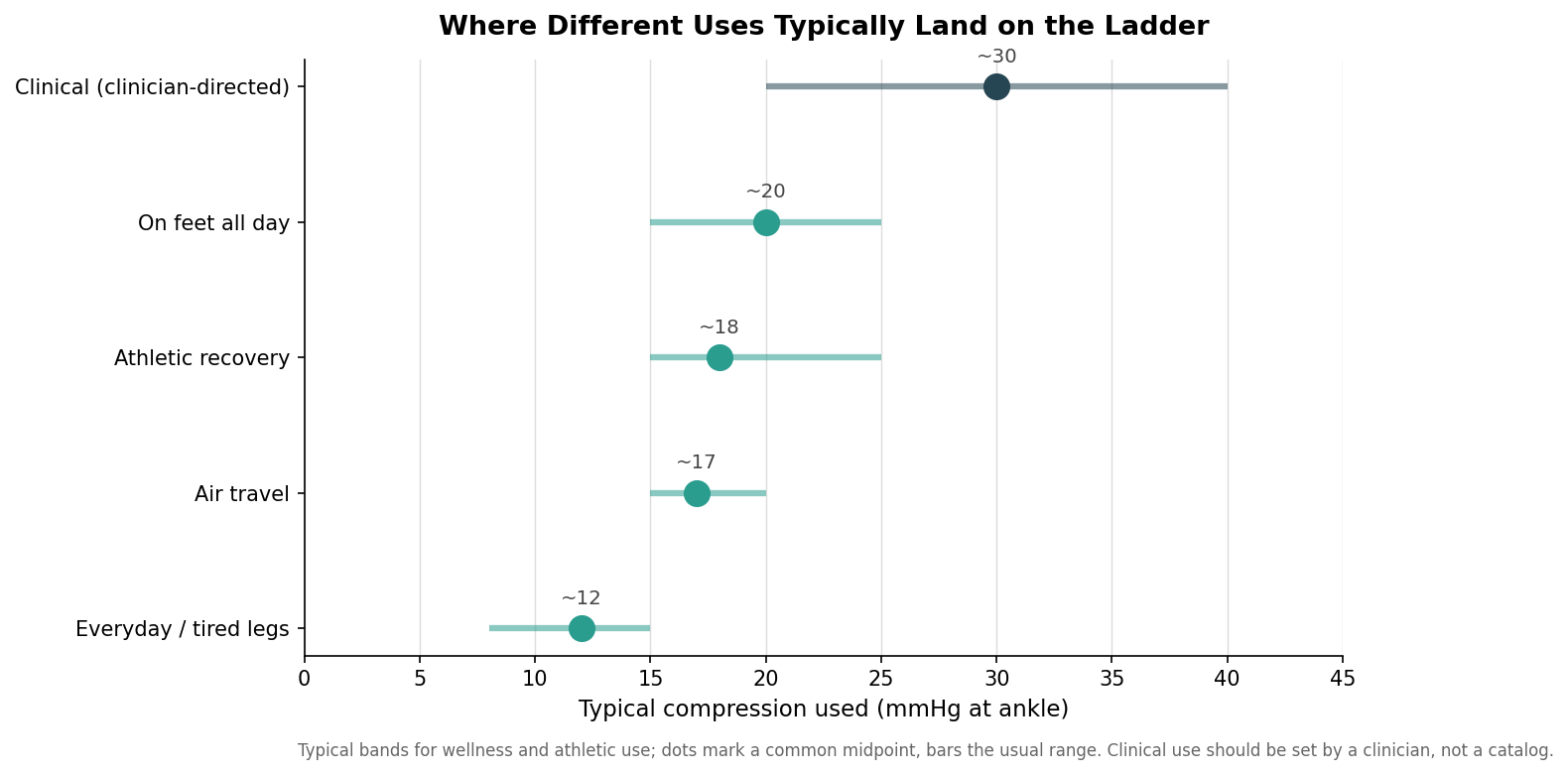
The pattern is clear: travel, sport, and standing-all-day uses cluster in the 15-20 to 20-30 window, while anything genuinely clinical sits higher and belongs in a clinician’s hands, not a catalog. If you are outfitting a nursing staff, a race team, or a corporate wellness giveaway, 15-20 mmHg is almost always the correct default, and 20-30 is the ceiling before the conversation changes.
The claims line a custom brand should not cross
The last piece is not about the sock but about what you say on the packaging and the website. A 15-20 mmHg branded sock marketed for comfort, energized legs, and recovery is a wellness product. The same sock described as something that treats, prevents, or cures a condition, deep vein thrombosis, lymphedema, chronic venous insufficiency, has just made a medical claim, and medical claims turn an ordinary sock into a regulated medical device in the eyes of the authorities. That reclassification brings requirements most custom-sock buyers never intended to take on.
The safe and honest approach is to let the compression level do the work and keep the language in the wellness lane: describe the mmHg, describe the feel, describe the use case, and stop short of promising a medical outcome. If a customer needs therapeutic compression for a diagnosed condition, the responsible answer is to point them toward a clinician and a properly fitted medical garment, not to stretch the claims on a branded sock to fit. Get the level right for the audience, pin the spec to explicit mmHg, and keep the claims honest, and a custom compression sock does exactly what it should without wandering into territory it was never built for.