Ordering custom compression socks for a group is easier once you stop thinking about a single “best” sock and start matching the sock to the wearer. A nurse on a twelve-hour shift, a frequent flyer, a marathoner, and a corporate wellness program all want different things from the same product category. The two decisions that matter most are the compression level and the build, and both follow from who is wearing the sock and what they are doing in it. Here is how to size those choices to real use cases, with a note at the end on getting your logo onto the sock without weakening what it does.
One caution up front. The guidance below covers general, over-the-counter use for healthy adults. Compression interacts with circulation, so anyone with a medical condition — peripheral artery disease, congestive heart failure, a skin infection, severe neuropathy, or diabetes with circulation problems — should confirm the right product with a healthcare professional before wearing it, and higher medical levels call for a proper fitting.
Start with the compression level, measured in mmHg
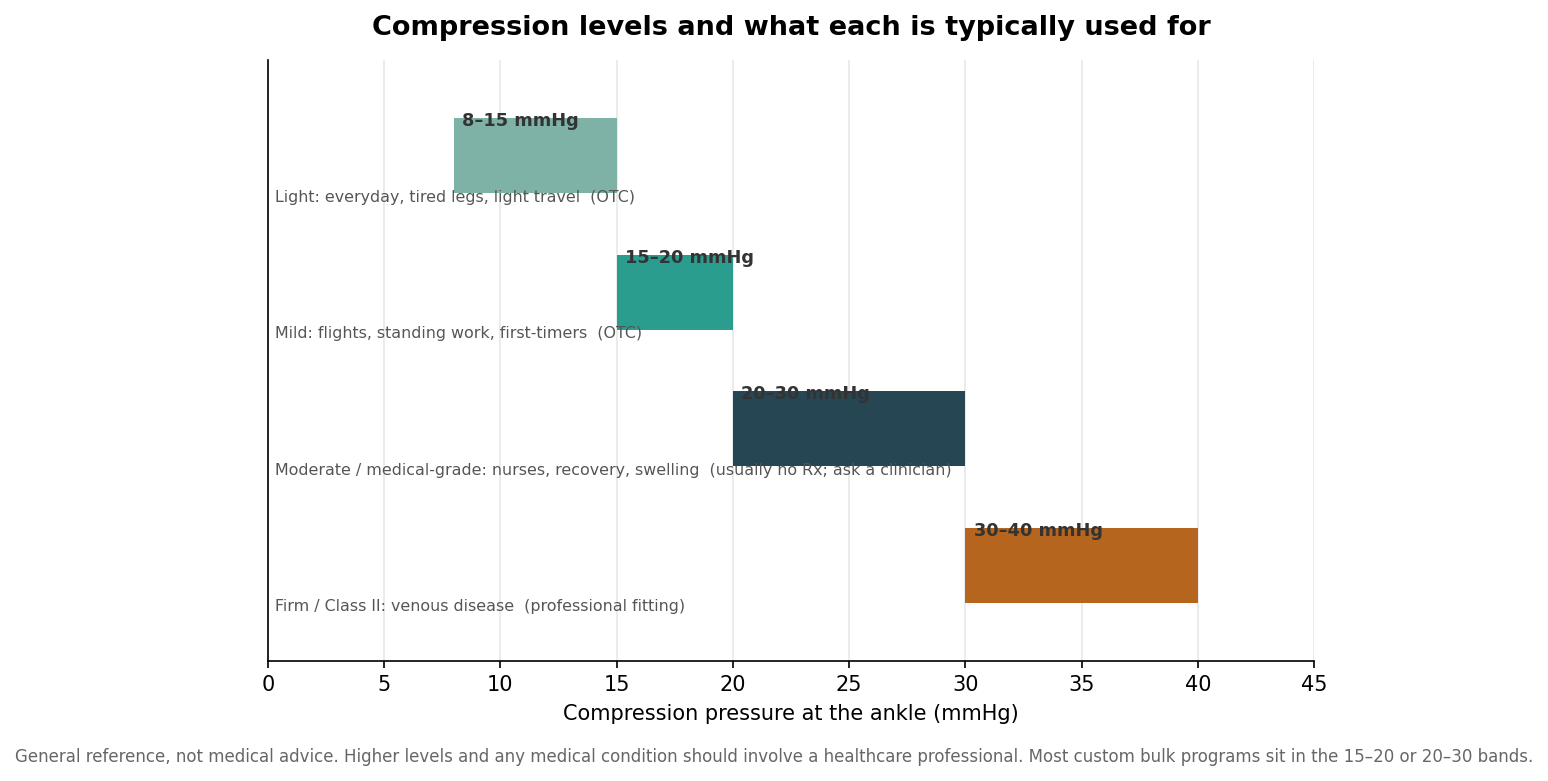
Compression is graded in millimeters of mercury, and the number describes the pressure at the ankle, which then eases up the leg. The 8 to 15 mmHg band is light everyday support for tired legs and short trips. 15 to 20 mmHg is the mild, over-the-counter workhorse: flights, long days on your feet, first-time wearers, and mild swelling. 20 to 30 mmHg is moderate, medical-grade compression that most people can still buy without a prescription; it suits demanding shifts, recovery, and more noticeable swelling, though it is worth a clinician’s input if any condition is in play. 30 to 40 mmHg and above is firm, Class II and higher, and that territory should be professionally fitted rather than guessed at. For custom bulk programs, the practical range is almost always 15 to 20 or 20 to 30, and choosing between those two is the core of the decision.
Nurses and workers on their feet all day
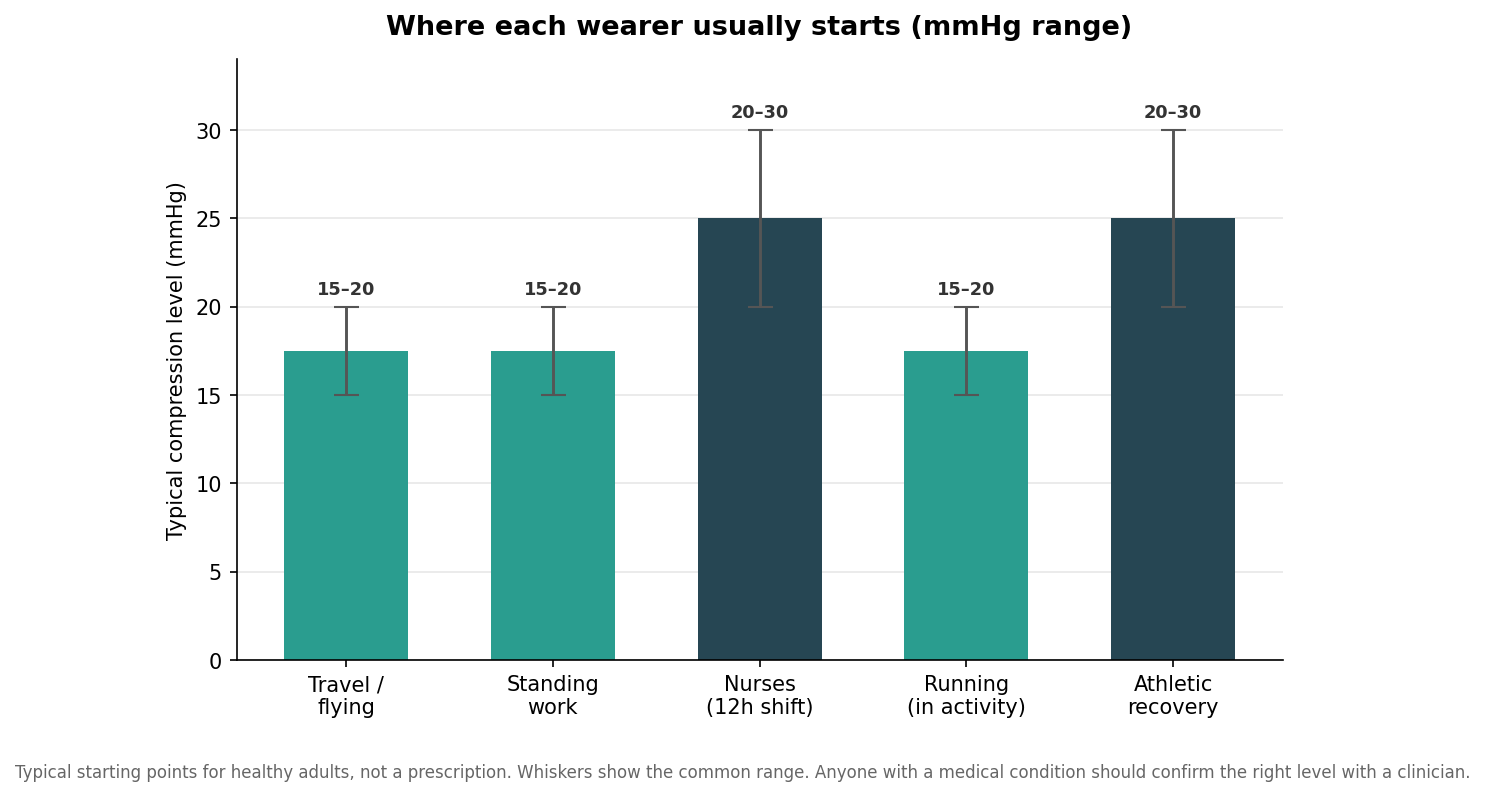
People who stand or walk through a long shift — nurses, hospitality staff, warehouse and retail workers — are the classic case for the firmer end of over-the-counter compression. A 20 to 30 mmHg knee-high is the common choice because the extra pressure does more to counter the pooling that a twelve-hour shift produces. Build matters as much as level here: look for a cushioned footbed for hours on hard floors, a durable knit that survives frequent washing, and moisture-wicking yarn so the sock stays comfortable through a full day. For a hospital, clinic, or facility program, this is also where consistent branding pays off, since staff wear the socks daily and in uniform.
Travelers and people stuck at a desk
For flying and long stretches of sitting, the goal is gentle, reliable support rather than maximum pressure. A 15 to 20 mmHg knee-high is the standard travel recommendation: enough graduated compression to keep blood moving on a long-haul flight or a full day at a desk, without the firmer feel that can put off a first-time wearer. The most useful habit to pass along to recipients is to put the socks on in the morning, before the leg swells, rather than mid-flight. A lighter, breathable knit works well for this audience, and because the wear is occasional, comfort and easy on-off matter more than heavy-duty durability.
Runners and athletes
Athletes use compression in two different modes, and they often call for different levels. During activity, many runners prefer 15 to 20 mmHg for a supportive, not-too-tight feel, and some choose calf sleeves instead of full socks so they can pair them with their own running socks. For recovery after a hard effort or race, 20 to 30 mmHg is common, worn for a few hours to help the legs feel fresher. Whichever mode you are outfitting, prioritize moisture management, a snug arch, and a cushioned heel and toe for impact. Team and event orders live here, and the branding question — club colors, sponsor logos, an event name — is usually front and center.
Getting your logo on the sock without weakening it
Custom compression socks are branded in two main ways, and the difference affects both the look and the compression. Knit-in designs build the color and logo directly into the sock as it is made, so the graphic is part of the fabric, holds up wash after wash, and does not add a stiff layer over the leg. The trade-off is that knitting favors bold shapes and a limited palette over fine gradients or photographic detail. Printed or sublimated designs apply full-color artwork to the surface and handle intricate graphics, but they belong on flatter, lower-stretch zones so the print does not fight the sock’s tension. The rule that protects performance is to keep heavy branding away from the graduated pressure zones around the ankle and calf, and let the cuff, foot, and upper leg carry the artwork. Decide length while you are at it — knee-high for graduated medical-style compression, crew or quarter for athletic looks, calf sleeves for runners who want their own socks underneath.
One last practical point for any program: compression is not permanent. With daily wear, socks gradually lose their stretch and should be replaced roughly every three to six months, so build that cadence into how much you order and how often you reorder. Match the level to the wearer, the build to the job, and the branding to the fabric, and a single custom order can outfit a very mixed group without compromising on what the sock is actually there to do.